ds^2 = dt^2(r – r_+)(r – r_-)/r^2 – dr^2[(r – r_+)(r – r_-)/r^2]^{-1} => (1-v^2)/t^2 where t^2 from I=F/dt =>I^2 => t^2=F^2:Impulse^2 => (1-v)(1+v)Impulse^2/mmaa => (1-v)(1+v)/m^2a^2 => (1-v)(1+v)/2m2a from m^2= cca 2m is elastic bang times impulse of force 🙂 I'm afraid ellastic bang does not move you to another universe?
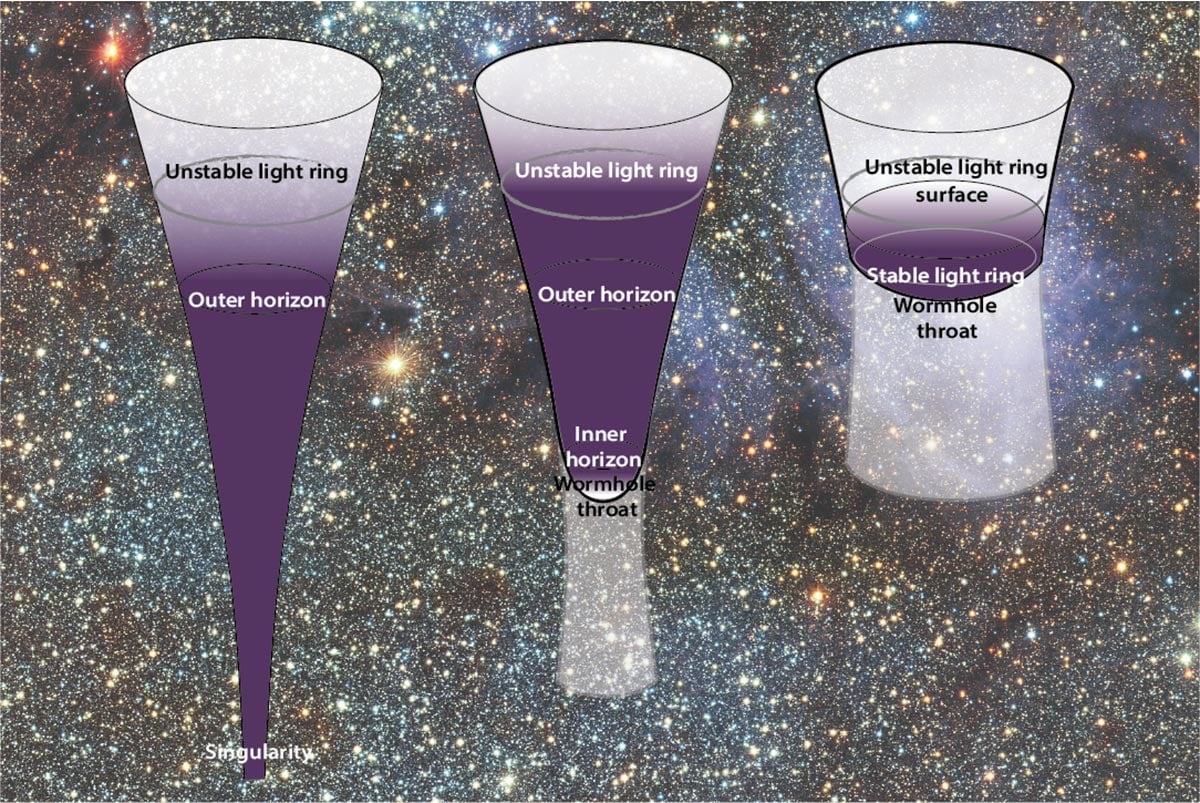
https://www.facebook.com/photo/?fbid=1235075235015867&set=a.110528997470502 https://scitechdaily.com/are-we-wrong-about-black-holes-a-radical-theory-challenges-einstein/ https://arxiv.org/abs/2504.17863 This revisits the mass-inflation singularity. If the Cauchy horizon is avoided then the mass-inflation singularity is not physical. In the exact Kerr solution the inner singularity is continuous with future null infinity I^+. This physically means that all photons that have entered the black hole form a Cauchy sequence of blue shifted photons that in the limit of the horizon have divergent energy. It does not even require real photons, for vacuum modes will diverge at the inner horizon r_- = m - √(m^2 - a^2). We can consider a stretched inner horizon that comprises the real quantum information that has entered the black hole and comprises the limit of this Cauchy sequence. This sequence will contain all the quantum states for massless fields, such as photons, that have entered the black hole, and also any information concerning massive particles that have reached this horizon. There is then a duality of quantum information between this Cauchy sequence and the outer horizon. The infalling observer will then encounter this inner horizon and access such information in the same way that an extremely accelerated observer ever closer to the outer horizon can access holographic information of everything that entered the black hole. Further, both are UV energetic and deadly. This is the mass inflation singularity, and why the inner horizon is considered unstable. The outer horizon and the actual spacetime horizon comprise an actual spacetime, where since the thickness of the radial direction is ℓs or ℓ_p are much smaller than the other two radial coordinates in differential form (2m dθ, 2m sinθdφ) this is approximately a 2-space plus 1-time BTZ sort of spacetime. This is a timelike spacetime. The dual inner horizon thickened region is a spacelike region. The split inner horizon can then be continuously deformed into a single thickened sheet, and it is FAPP not that different from the Schwarzschild singularity. What happens to the inner timelike region with a circle or ring singularity? That region may in some sense still exist. The particles that cross this mass inflation singularity are scattered by Planck energy quantum states, such as extreme photons. This does not necessarily mean they are annihilated into nothingness. They just may be scattered into this interior region. The outer horizon in holography defines a duality between states outside that horizon and quantum fields on the outer horizon. From the perspective of an observer who crosses the outer horizon the quantum fields outside just proceed inwards, so the duality extends accordingly. The same then holds for this inner horizon. Quantum information an infalling observer finds before crossing the inner horizon will continue. This infalling observer must contend with this “firewall” of Planck modes at the inner horizon, but if that observer is boosted on a frame sufficient to redshift this enough that observe might then survive. In this paper the singularity is removed by considering a mass M, with m = GM/c^2, that is a function of radius m = m(r), so that in the case of the Schwarzshild metric with g{tt} = 1/g_{rr} = 1 - 2m/r has a “smearing out” of the matter. In effect with what I present above something similar to this happens, but with the smearing and m(r) different from a singular distribution significant near the Planck scale. The curvature R_{rtrt} = m/r^3 will for a particular function m = m(r) grow enormously up to the Planck scale and then “smooth out” to avoid a sharp singularity at r = 0. The Kretschmann invariant K = R_{abcd}R^{abcd} = 48m^2/r^6 is modified and in this paper it is of a polynomial form. This is then a phenomenological for how quantum physics can prevent the absolute singularity. We might consider the m(r) = m + sum_n αn(ℓ_p/r)^nL_n(r), for L_n(r) Laguerre polynomials or related orthogonal polynomial series. These can form the orthogonal basis for quantum states. This would then “soften” the mass inflationary singularity at the inner horizon. Carrol, Johnson and Randall (2009) showed that the extremal limit of a black hole where r _+ = r- = m maps the inner spacelike region between the two horizons into AdS_2×𝕊^2. This can be seen with the Riessnor-Nordstrom metric ds^2 = dt^2(r – r_+)(r – r_-)/r^2 – dr^2[(r – r_+)(r – r_-)/r^2]^{-1} – (d𝕊^2)^2 Then let r_+ = m + ε, and r_- = m – ε take the limit ε → 0, do some algebra to remove coordinate singular terms and we get the metric ds^2 = (m/r)^2dt^2 – (r/m)^2dr^2 - (d𝕊^2)^2, which is the metric for AdS_2×𝕊^2, the anti-de Sitter spacetime in two dimension tensored with the 2-sphere. The interior timelike inner region of a black hole has topology S^1×ℝ^1×𝕊^2 and shares topology with AdS_2×𝕊^2. The merging of these two extremal regions means the interior spacetime topology connects with holographic projection of states. This of course means that if you fell into a black hole that inner horizon or mass-inflation surface would be devastating. You would need to be boosted on an extreme frame in order to red-shift away the damaging influence of these Planck energy photons. This of course assumes you can get to the central black hole in this galaxy SagA*, only 27,000 light years away, and tidal forces would be probably considerable before you reach the inner horizon. This is then science fiction, but so long as we are thinking that way you might want to upload your mind onto a computer chip a few millimeters in scale.

Comments “Today discussing challenging Einstein seems to be just ellastic collision in black hole:”