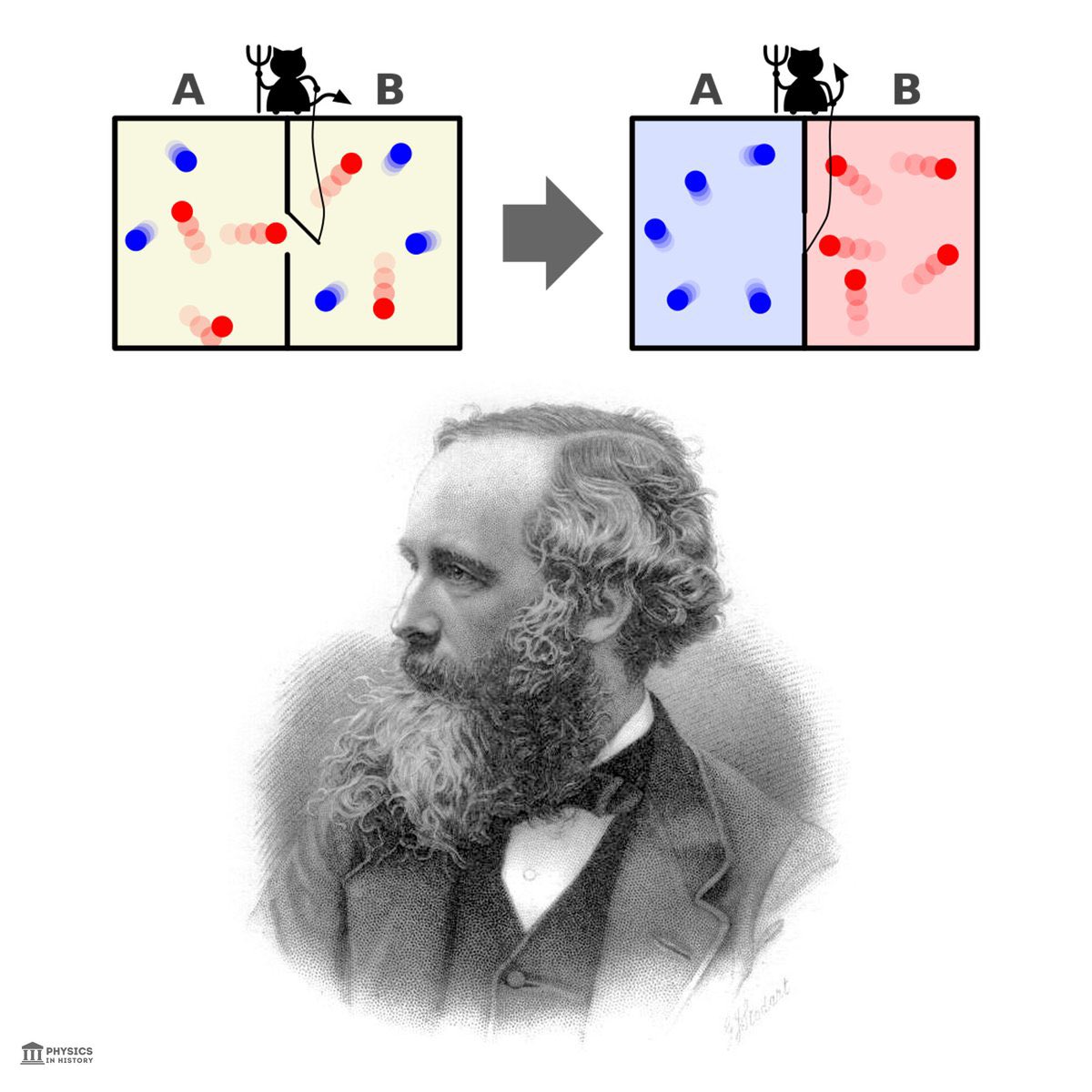
Zaujímavá otázka na Mexwelovho démona. Veľmi podobná situácia, NIE VŠAK JEDINOU DIERKOU sa deje na Viadruske peci v kotólni: Majme horiacu komoru liatinovej pece, kde horí drevo. O chvíľu otvoríme na zavretých dverách malý krúžok á vriace molekuly, puff von krúžkom, necháme ho otvorený a natiahne to studený vzduch krúžkom do pece a o chvíľu puff von vriace plyny krúžkom. Nó, toto sa deje v kotólni, len si treba zdvihnúť zadok a ísť priložiť drevka do pece páni fyzici ;) Srandičky nó :) Á tak DISKUTUJME, nikto nevie všetko...
zdroj: https://x.com/PhysInHistory/status/1999442990490890483/photo/1
Maxwell’s demon is a hypothetical being that can violate the second law of thermodynamics, which states that the entropy of an isolated system can never decrease over time. Entropy is a measure of disorder or randomness in a system. The more disordered a system is, the higher its entropy.
The demon was imagined by the physicist James Clerk Maxwell in 1871 as a way to illustrate the possibility of creating order from disorder without doing any work. He envisioned a box divided into two chambers, each containing gas molecules at the same temperature and pressure. The demon can observe the speed and position of each molecule and control a tiny door between the chambers. The demon’s goal is to make one chamber hotter and the other colder by letting only fast molecules pass from left to right and only slow molecules pass from right to left. This would create a temperature difference between the chambers, which could be used to do work, such as turning a wheel or generating electricity.
However, most scientists argue that Maxwell’s demon cannot actually violate the second law of thermodynamics, because the demon itself would have to do some work to observe and manipulate the molecules. This work would increase the entropy of the demon’s surroundings, which would cancel out the decrease in entropy of the gas. Moreover, the demon would have to store information about each molecule it encounters, which would also increase its entropy. To erase this information and reset its memory, the demon would have to dissipate heat, which would again increase the entropy of the system.
Therefore, Maxwell’s demon is not a real physical entity, but a thought experiment that illustrates the connection between thermodynamics and information theory. It also shows that entropy is not only a property of matter, but also of information and computation. Maxwell’s demon has inspired many researchers to explore the limits of thermodynamics and information processing in various fields, such as quantum mechanics, nanotechnology, biology, and cosmology.

Comments “Už ste videli Mexwelovho démona vo Viadruske liatinovej, keď ste kúrili pre domácnosť? Ja už áno :)”